
Date Saranac Lake Results
Dates keep a Saranac Lake search honest. Attach the roll year, deed recording date, permit date range, and access date to each result, because dates hold the two town layers and changing parcel records in the right order.
Saranac Lake Search Checklist
Write down the street, SBL, owner field, deed reference, roll year, and village request date. Mark whether the entry sits in North Elba or St. Armand. That label matters. Search both county municipality choices when the first attempt fails. Historic building names and directories are only leads. Let the matching parcel and legal description finish the job. Keep each clue with its source so a North Elba parcel never blends into a St. Armand result.
Search Saranac Lake Property Records
Essex County keeps the deed, assessment, tax-map, and county tax layers for every Saranac Lake parcel. The village handles code enforcement and local land use. Start with the address in PROS. If that property search stalls, try both Village of Saranac Lake municipality entries, because the village spans North Elba and St. Armand in the county system. The right entry depends on the town, not the mailing address.
- Search the street through PROS Street Finder.
- Test both North Elba and St. Armand village entries.
- Copy the correct SBL and owner field.
- Confirm the deed in SearchIQS and the parcel in GIS.
- Request public permit or development records from the village.
Who Keeps Saranac Lake Records
The Essex County Clerk records deeds, mortgages, liens, maps, assignments, and satisfactions. RPTS handles the PROS property search. It also runs rolls, tax maps, exemptions, equalization data, and GIS links. County tax accounts sit with the Treasurer. So do delinquent records. Village permits go to Saranac Lake Code Enforcement. Land-use decisions rest with the Development Board.
Essex County property custodians
County Clerk, RPTS, and Treasurer
Elizabethtown, New York
The village is not the recorder. Legal instruments remain county records.
Two Saranac Lake Jurisdictions
PROS separates Village of Saranac Lake (North Elba) from Village of Saranac Lake (Saint Armand). A failed property search under one entry should be repeated under the other. The postal name alone never settles town jurisdiction.
The split decides which assessment and tax roll applies. Keep the SBL constant as records move between county systems. When an old document names only Saranac Lake, use the street, legal description, and map clues. Those details pin down the right municipal layer.
Saranac Lake Neighborhood Records
Saranac Lake places take shape in the records through town layers, streets, tax-map parcels, recorded maps, neighborhood codes, and historic building names. Those official clues travel well. An informal neighborhood label does not.
| Neighborhood or record area | Record era | How it appears |
|---|---|---|
| Village core | Historic to current | Street, parcel, deed, and permit |
| North Elba village portion | Current roll | Separate PROS municipality entry |
| St. Armand village portion | Current roll | Separate PROS municipality entry |
| Recorded subdivisions | Map-specific | Plat, lot, deed, and clerk map |
Take the subdivision name from the plat or deed.
Saranac Lake Permit Files
Saranac Lake Code Enforcement posts information and forms for regulated work, including alterations, roofing, signs, demolition, and inspections. Development Board material covers applications such as variances, site plans, special uses, and subdivisions. No permit-result search interface is published. Use the forms and office contact.
| Request detail | Purpose |
|---|---|
| Property address | Locates the village file |
| SBL | Separates similar addresses |
| Owner or applicant | Supports name search |
| Work type | Narrows permit category |
| Date range | Narrows inspections and decisions |
The official Code Enforcement page shows permit triggers, inspections, office details, and forms.
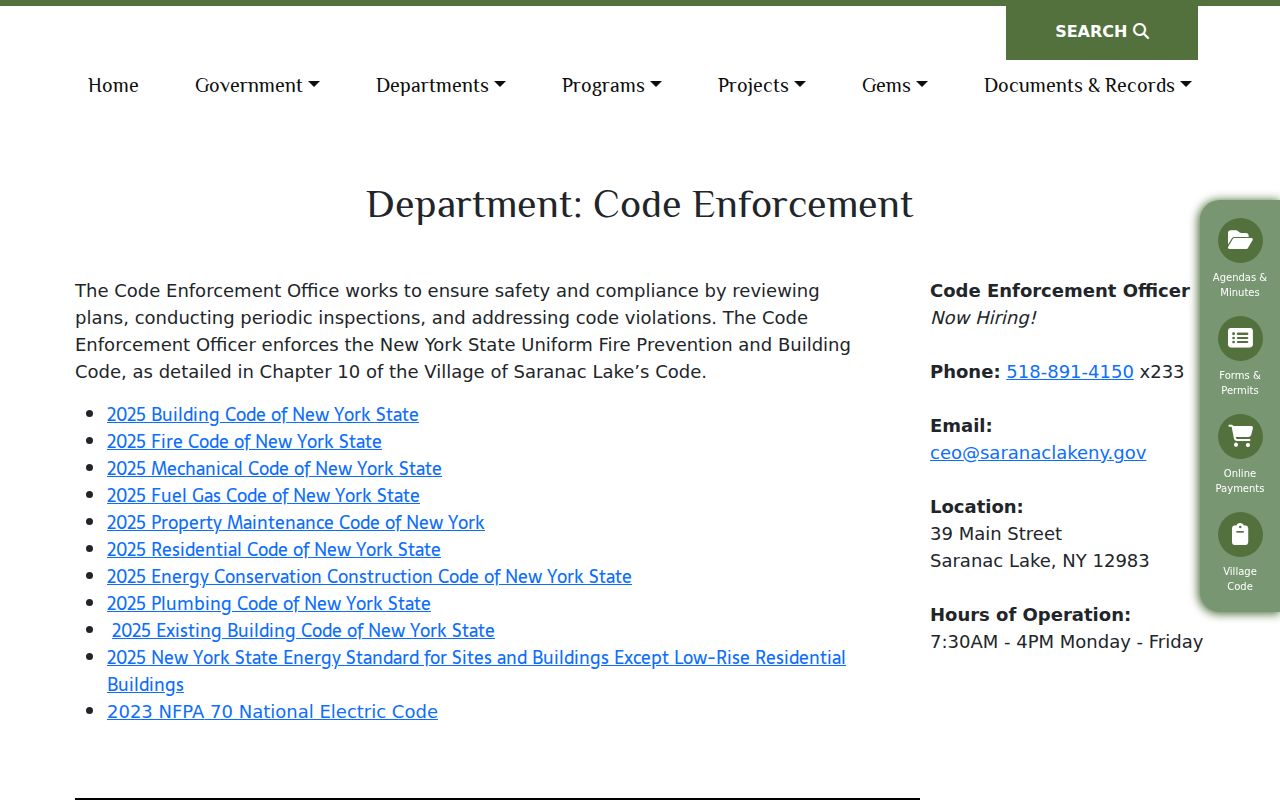
The captured page identifies the proper village access point for local building records.
Street Finder in Saranac Lake
The PROS Street Finder lists parcels on a named street. It helps when the GIS viewer runs slowly. It also works when a house number is uncertain, or when a road crosses both town contexts. Record each candidate's address, SBL, owner, municipality, and class before mapping it.
A street list is not an adjacency list. Rural roads and rear parcels can mislead. Confirm the spatial relationship in GIS. Rely on a recorded plat or survey when the actual boundary matters.
Saranac Lake Historic Names
Old names open doors in Saranac Lake research. The Saranac Lake Free Library's William Chapman White Adirondack Research Room, Historic Saranac Lake, and the Adirondack History Center hold directories, newspapers, maps, photographs, and building-name clues. These help when a deed or permit uses an old camp, institution, road, or owner name.
Carry each clue into PROS, SearchIQS, WebSurrogate, or the clerk's historical books. Stop at evidence. A plausible story is not a match. The finishing point is a matching parcel and legal description.
Saranac Lake Value Checks
Read the roll under the right town layer. Note the land value, total assessment, taxable value, exemptions, full-market field, roll year, and municipal equalization context. A cross-town raw assessment comparison can mislead.
Sale price follows a separate trail. The last sale price comes from the deed and sale records, which may cover multiple parcels or a non-market transfer, so confirm the legal description before treating it as a value reference.
Limits of Saranac Lake Records
Saranac Lake property records can tie an address to public parcel, owner, deed, tax, map, and permit evidence. They can't do everything. No record insures title, certifies a GIS boundary, proves occupancy, or fills a protected address field.
Lawful use. Use Saranac Lake records for property diligence, history, tax review, and boundary work. Never use them to track, harass, or harm a person.
How to Search Essex County records Property Records
Essex County keeps the property records for this area. The county's property-search portal, deed index, tax roll, and GIS map carry the parcel, deed, and assessment material. The city does not hold them.
- Essex County records address]
- Essex County records
- Essex County records
- Essex County records
- Essex County records's own permit / zoning lookup for the property's work history]
Essex County records
Where Essex County records Property Records Are Kept
Deeds and maps live with the county clerk. RPTS handles assessments, and parcels appear on the county tax roll and GIS map; the city side covers building permits, zoning, and code cases in offices it runs itself. Each layer has its own keeper.
Essex County Records (deeds, taxes, parcels)
[1-2 lines - the county recorder/assessor/treasurer hold every Essex County records property record; link the main portal]
Essex County records Permits & Zoning
Essex County records
Essex County records, NY Essex County records
Essex County records
Essex County records Neighborhoods and Subdivisions in the Records
Plat names appear throughout the county records. So does the era a subdivision was built. A subdivision name pulled from a plat can unlock a deed or parcel search when an address alone comes up empty.
| Neighborhood / Subdivision | Era | In the Records |
|---|---|---|
| Essex County records | Essex County records | Essex County records |
| Essex County records | Essex County records | Essex County records |
| Essex County records | Essex County records | Essex County records |
Essex County records
What Essex County records Property Records Show and Their Limits
Essex County property records cover ownership, assessed value, and encumbrances, plus permits in some cases. They are official documents, drawn from the county's own books.
They have limits. A property record is not a title search. It is not a survey. It is not a market appraisal.
Lawful use. [1-2 sentences - Essex County records property records are open for property research, due diligence, and civic transparency; misusing owner information to harass anyone is a crime under New York law.]