
Essex Record Dates Matter
Keep the roll year, recording date, and map date with each result. Systems update on separate schedules. So one parcel may look different in two places. A dated conflict is a question for the right office.
Search Essex County Property Records
Start in PROS, the Real Property Tax Services assessment system. It answers most first questions. It accepts an address, owner name, tax map number, or street-finder query. A clean match returns the SBL identifier, municipality, and property class. It also shows the owner carried on the roll. That number beats a name every time. Surnames repeat, and rural mailing addresses rarely match physical sites.
Carry the parcel number into the County Clerk's SearchIQS deed index next. Then check the Treasurer for tax bills and payment status. The GIS viewer adds the ground-level picture. Each system answers one question. An assessor name is not title. A deed index skips off-record claims. A tax-map line is not a survey.
- Enter the address in PROS. If it fails, use Street Finder or search both the owner and municipality.
- Copy the SBL and open SearchIQS to identify the latest deed and its prior-deed reference.
- Check assessment and tax rolls, then the Treasurer lookup, using the same parcel identity.
- Open the GIS viewer and compare roads, adjoining parcels, and available reference layers.
- Ask the County Clerk, RPTS, Treasurer, or local code office for material that is not online.
Essex County Records Offices
The record trail runs through three county offices in Elizabethtown. The County Clerk records deeds and other land instruments. Real Property Tax Services keeps the assessment rolls, tax maps, exemptions, equalization data, and GIS. The Treasurer holds tax-account history, delinquent payments, and foreclosure notices. Town and village assessors add local detail. They never replace the county deed record.
Essex County Clerk
7559 Court Street, PO Box 247
Elizabethtown, NY 12932
518-873-3600
Real Property Tax Services
7551 Court Street
Elizabethtown, NY 12932
518-873-3390
Essex County PROS Search
PROS works as the front door for Essex County property records. The quick search offers Street Address, Tax Map Number or SBL, Owner Name, and Street Finder. The advanced screen goes further. It filters by municipality, property class, sale dates, sale price, value ranges, building traits, and waterfront. Those extra filters rescue searches when an address is old, incomplete, or shared by several structures. An address can be old. It can be incomplete, or shared by several structures. The filters still rescue the search.
The official PROS quick-search screen lays out the fields that begin an assessment lookup.
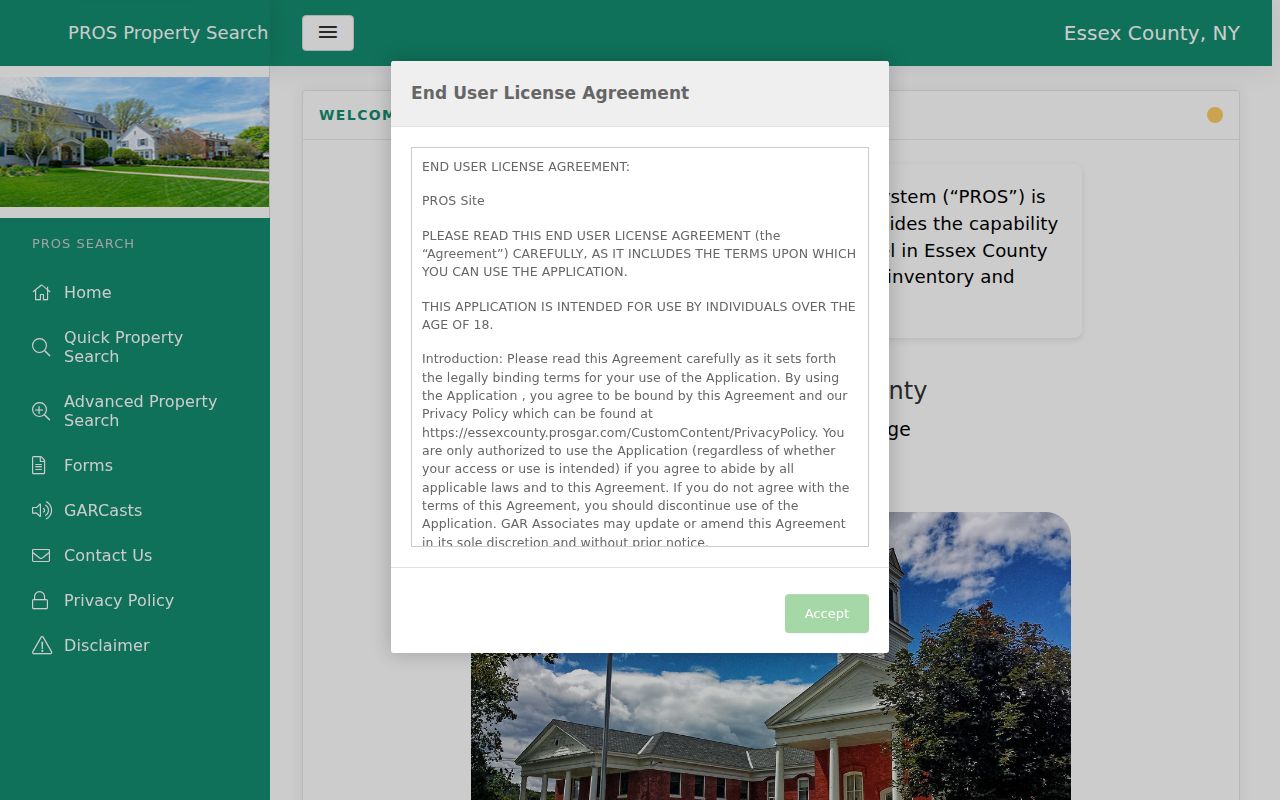
Address, owner, SBL, and street-list searches each reach the same roll through a different door.
| Field | Best Use | Search Note |
|---|---|---|
| Street Address | Known site | Try without a road suffix if needed |
| Tax Map # / SBL | Exact parcel | Best cross-system key |
| Owner Name | Known person or entity | Try surname and entity variants |
| Street Finder | Whole road or block | Useful for rural and neighbor work |
Advanced Essex Parcel Filters
The advanced screen lets you pick a municipality before touching sale or building filters. That matters here. Essex County holds eighteen towns and incorporated and former villages. Its postal names ignore assessing boundaries. Saranac Lake splits across North Elba and St. Armand in its Essex County portion. Lake Placid records may carry either the village or North Elba label.
The official advanced-search page displays the sale-date, neighborhood, class, value, structure, and waterfront controls.
Apply broad filters first, then confirm each candidate by SBL, situs, and deed reference.
Types of Essex Property Records
No single file holds an Essex County property. Records here are linked sets built for recording, assessing, collecting, mapping, and land-use work. Each set proves something different. A deed documents a conveyance, the roll shows the current assessment account, and GIS supplies reference geography.
| Record Type | What It Documents | Kept By | Access |
|---|---|---|---|
| Deeds | Recorded transfers and legal descriptions | County Clerk | SearchIQS, clerk counter, older books |
| Mortgages and liens | Recorded claims and releases | County Clerk | SearchIQS and clerk files |
| Assessment and tax | Owner field, values, exemptions, levies | RPTS and Treasurer | PROS, rolls, tax lookup |
| Maps and parcels | SBL, reference lines, roads, layers | RPTS and County Clerk | GIS, tax maps, recorded maps |
| Permits and zoning | Public land-use applications and work | Town or village | Local office and forms |
Use deeds for the transfer trail. Use assessment records for the current roll. Tax files cover account history, and maps add context. Deed research in depth belongs in the Essex County deed records workflow. Assessments and bills follow a separate tax-record route. Permits stay municipal, so identify the town or village before requesting them.
Deeds Across Two Eras
Deed research in Essex County spans two distinct eras. The Clerk's online SearchIQS index covers modern deeds and mortgages from 1973 forward. Older deed books and images generally run from 1800 through 1972. Grantor-grantee index material goes back to 1799. The gap between eras matters. A search that stops at the web cutoff misses most chains reaching into the nineteenth century.
Work backward from the newest deed, noting each grantor and prior book-and-page reference. FamilySearch catalogs Essex deed books and general indexes for 1799 through 1920. The New York State Archives guide and local archives help with vanished place names. The County Clerk stays the legal custodian regardless.
The FamilySearch Essex deed catalog shows the bridge across the older books and indexes.
Note: this finding aid aids older research, but the recorded county copy controls when proof matters.
Essex Tax and Value Trail
An assessment roll and a tax roll do different work in Essex County. The assessment roll carries the parcel identity, the owner of record shown on the roll, situs, acreage, land and total assessment, taxable values, exemptions, and full-market-value fields. A tax roll then applies the county, town, school, or village rate. That rate turns the assessment into an actual charge. The Treasurer's property lookup adds account history and unpaid-tax details on top. Be careful comparing raw numbers across towns. New York equalization rates describe how each municipality's roll relates to full market value. Essex County municipal rates differ from one another. Exemptions can shift taxable value while leaving the parcel's underlying assessment untouched. A sale price sits apart from all of this. It comes from transfer data and the deed trail, not from the current tax bill.
Essex GIS Has Limits
The Essex County RPTS GIS information page gathers the county viewer, tax-map products, county map layers, population maps, and FEMA material. Everything sits in one spot. A parcel polygon is a starting point. It shows adjacency fast. Use it to compare neighboring SBLs and see how roads relate. It also helps you choose which recorded map or plat to request. PROS Street Finder serves as a fallback. It also backs up the adjacency tool when that feature misbehaves.
Remember what a highlight is not. A colored polygon cannot settle a disputed line, an easement, or a shore boundary. It cannot settle a buildable envelope either. Match the tax map against the legal description, the recorded subdivision map, and any survey. Rely on it only after that. The 2026 RPTS fee schedule prices custom GIS work apart from standard maps. So define the parcel and the layers you need before ordering.
Municipal Essex Permit Records
Permits and zoning files follow the town or village, not the County Clerk. Each Essex County municipality runs its own counter. Saranac Lake Code Enforcement posts permit and inspection routes for alterations, roofing, signs, demolition, and other regulated work. The combined North Elba and Lake Placid government site routes visitors to assessment, planning, zoning, clerk, and building functions. Other towns and villages keep their own channels.
Start with the SBL and the true jurisdiction. A Lake Placid mailing address can sit on land outside the village, and Saranac Lake itself spans more than one town. Ask the code office for public permits, certificates, planning decisions, and zoning applications tied to the parcel. Missing permits prove nothing. Old buildings and pre-digital records often explain the gap.
Historic Essex Land Clues
Old deeds sometimes surface in unexpected places. County courthouse history records an 1809 deed at Liber A, page 450. It covered the land for the courthouse and gaol. That book-and-page clue links civic history to the deed system. Fires and rebuilding mark the Essex County story. Even so, do not assume the land records were lost. Older searches should follow the surviving index and book trail rather than presume a gap.
Nearby libraries carry the softer clues. The Adirondack History Center Museum's research library holds newspapers, maps, cemetery information, photographs, and manuscripts. The Saranac Lake Free Library adds the William Chapman White Adirondack Research Room. It offers local names, directories, and newspaper leads. An old camp name or former road name can emerge there. Carry each clue back to the official index. Stop only when the legal description and parcel identity agree.
FOIL for Missing Essex Records
Some public Essex County records simply never get posted online. Ask the responsible office first. Regular channels may include a public terminal, mail copies, or a routine copy order. When none of those fits, the county's Freedom of Information Law procedure names the records access officer, the inspection process, the fees, and the appeal officer. New York Public Officers Law Article 6 governs that route.
A good request stays narrow. Give the record type, date range, town or village, parcel SBL, names, and any known book and page. FOIL cannot force an office to create a new analysis or answer a research question. Protected information stays protected. Narrow requests are also easier to locate and review, which speeds the response. Court, vital, voter, and address-confidentiality records follow separate statutes even when a request concerns land.
Limits of Essex Property Records
Essex County property records reveal a great deal. The tax roll names an owner of record. Deed records show transfers, mortgages, satisfactions, and liens. You can also trace assessment figures, tax charges, plat maps, and public permit activity. Gaps still appear, though, and a few of them matter. A freshly recorded deed may reach the recorder before the next roll update. That is common right after the March 1 assessment-status date. A parcel split can linger on the original tax bill. The original entry stands until a later roll catches up.
One record cannot answer every question. Public records never guarantee that the person named on a deed lives at the situs. Mailing and site addresses often differ. New York's Address Confidentiality Program and other laws can shield certain information as well. Treat the SearchIQS fraud alert as a notice tool rather than title monitoring. It watches up to ten names. An alert says nothing about whether a filing is valid.
Lawful use. Essex County records support due diligence, boundary research, tax review, and house history. They do not replace a title search or survey, and they must never be used to harass or harm a person.